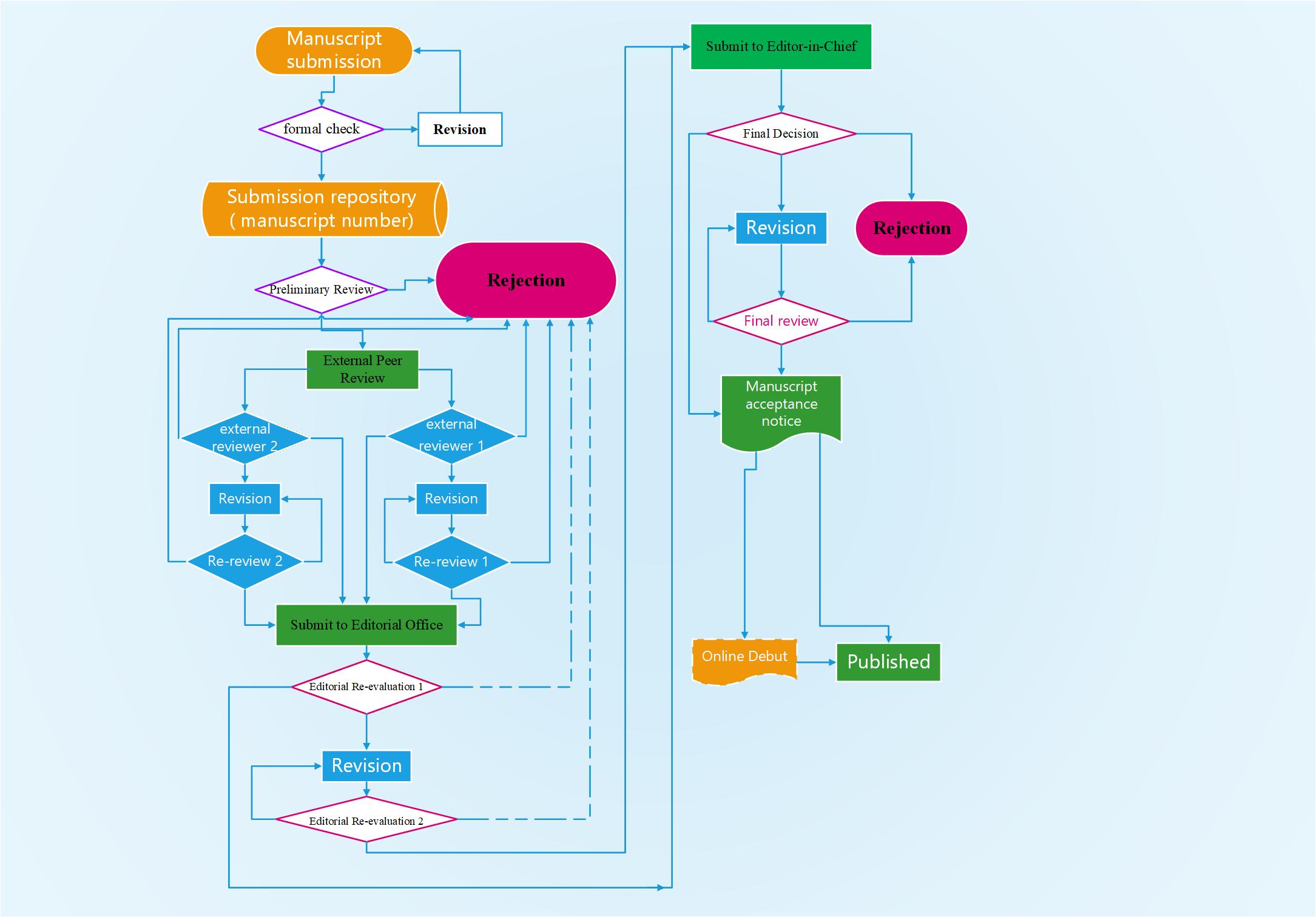
This journal adheres to a double-blind peer review system, upholding the principles of fairness, impartiality, and selecting the best manuscripts for publication. The editorial process primarily consists of the following stages:
This stage involves both formal checks and content evaluation.
(1) Formal Check: The editorial office conducts a formal review of submissions, focusing on requirements such as anonymization. Manuscripts that do not meet these criteria will be returned to the author for resubmission.
(2) Content Screening: Once a manuscript passes the formal check, the editorial office will assign it a reference number, notify the author of successful receipt via email, and proceed with a content evaluation.
Outcomes of the Preliminary Review:
(1) Sent for External Review: Manuscripts deemed to have publication value after the initial screening will be sent to external experts for peer review.
(2) Rejection: Manuscripts not meeting the basic criteria will be rejected.。
External reviewers evaluate the manuscript's topic selection, argumentation, methodology, data, and conclusions. They assess the work for innovation, logic, and scientific validity, and provide review recommendations. The recommendations generally fall into three categories:
(1) Reject: Recommended for manuscripts that fail to meet the journal's standards.
(2) Accept: Recommended for high-quality manuscripts that meet all publication requirements.
(3) Revise and Resubmit: For manuscripts that do not yet meet requirements but possess potential and value for improvement, reviewers will provide specific comments for revision. For manuscripts requiring revision, the editorial office will return them to the author. Upon completion of the revisions, the author must submit the revised manuscript along with a response letter. The editorial office will then submit these documents to the reviewers for a second round of review. Based on the reviewers' feedback, the editorial office will decide whether to proceed to the Editorial Re-evaluation or reject the manuscript.
For manuscripts that reviewers deem to be sufficiently improved and meeting publication standards, the editorial office will conduct a re-evaluation. They will decide whether to forward the manuscript to the Editor-in-Chief for the final decision, request further modifications, send it for additional external review, or reject it.
The Editor-in-Chief makes a comprehensive judgment on the manuscript, deciding whether to accept it, request revisions for another round of review, or send it for additional external review.
For manuscripts accepted by the Editor-in-Chief, the editorial office will notify the author via email to upload the non-anonymized (identified) version of the manuscript and relevant attachments (such as the copyright agreement) to the submission system.
The "Revision" stage is conducted via email notification and the submission system. In this process, authors are required to submit a marked-up manuscript (using "Track Changes" or similar) accompanied by a detailed response letter.
The response letter should be detailed, addressing each comment point-by-point. Revised sections in the manuscript should be highlighted in a different color to facilitate review by the editors or reviewers. Authors must return the revised manuscript within the specified timeframe; if unable to do so, they must submit an explanation and a request for an extension.
Note: Since some manuscripts require revision before being sent back for external review, the "External Review" and "Revision" stages may occur iteratively.