Loading...

Current Issue

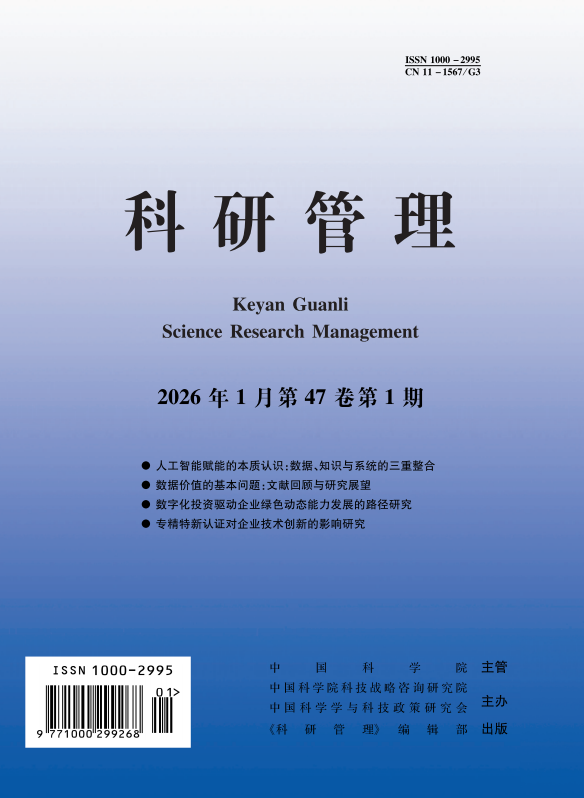
    20 January 2026, Volume 47 Issue 1 Previous Issue   

    6561D43B-1C2
    For Selected: Toggle Thumbnails
    6561D43B-1C2
    The essence of AI-enabled empowerment: A tripartite integration paradigm of data, knowledge and systems
    Pan Jiaofeng, Wang Chuyang, Wu Jing
    2026, 47(1): 1-10.  DOI: 10.19571/j.cnki.1000-2995.2026.01.001
    Abstract ( 194 )   PDF (1170KB) ( 92 )  
       Artificial intelligence is a typical interdisciplinary field that integrates multiple disciplines and domains, exhibiting strong pervasiveness and convergence. Against the backdrop of the deepening implementation of the "AI+" initiative, adopting an integrative perspective to dissect the underlying logic of AI-enabled empowerment and systematically clarifying its essential mechanisms is of paramount theoretical and practical significance. This effort is crucial for identifying key pathways for the deep integration of AI with various sectors, promoting the practical application of AI, and optimizing AI governance. Based on this, this paper proposed that the essence of AI-enabled empowerment lies in the triple integration of "data integration, knowledge integration, and system integration". Specifically: (1) Data integration enables the integration of cross-modality, cross-spatiotemporal, and cross-domain datasets; (2) Knowledge integration drives five core capabilities: association recognition, causal reasoning, contradiction discovery, convergence approximation mutation emergence; (3) System integration achieves the engineering implementation of foundational technologies, functional technologies, and domain-specific technologies. To address challenges in integration—including inadequate data circulation mechanisms, algorithmic bias and decision-making deviations, and increased system security vulnerabilities—the following recommendations are proposed: (1) data circulation frameworks and standardization protocols should be refined to strengthen full-lifecycle data security safeguards; (2) algorithmic bias governance should be enhanced to improve model transparency and interpretability; and (3) the implementation of intelligent system integration should be pioneered to advance engineering resilience and ethical compliance capabilities. This study will provide valuable insights and references for promoting the healthy development of artificial intelligence and driving the intelligent transformation and upgrading of industries.
    Related Articles | Metrics
    Fundamental issues of data value: A literature review and research prospects
    Qin Haolang, Xiao Yangao, Tang Jiaodong, Li Daitian, Liu Yulin
    2026, 47(1): 11-24.  DOI: 10.19571/j.cnki.1000-2995.2026.01.002
    Abstract ( 82 )   PDF (1639KB) ( 53 )  
      Realizing the value of data elements constitutes both a significant theoretical issue and an urgent practical demand for enterprise development in the digital economy era. This study systematically reviewed the literature on data value published between 1991 and 2024 in the fields of management and law. Drawing on the grounded theory for data coding, it distilled three fundamental questions of data value: which categories of data are of value? What forms of value can be derived from data? How is the value of data realized? The three issues respectively correspond to the value attributes of data, contents of data value, and the mechanisms by which that value is realized. The research indicated that: (1) The value attributes of data manifest as inherent intangibility, technical reusability, increasing returns to scale in economic terms, and limited exclusivity of rights; (2) The value of data encompasses economic, social, and political dimensions. From the perspectives of data stakeholders, namely data operators, data providers, and data governors, their respective value objectives are to enhance productive efficiency, achieve digital equity, and ensure data security; (3) The mechanism for realizing data value primarily encompasses the stages of value creation, value circulation, and value distribution. Data value creation is fundamentally grounded in data standardization, which specifically includes the assetization, productization, and capitalization of data. The circulation of data value faces pressing challenges in pricing, necessitating the orderly advancement of data trading, openness, and sharing. Through initial allocation and subsequent redistribution of data value, improvements in economic efficiency and the realization of social equity can be promoted. Finally, the paper outlined prospective research directions concerning the theoretical frameworks and methodologies underlying the systemic operation and realization mechanisms of data value.
    Related Articles | Metrics
    A study on the high-quality development mechanism of SRDI enterprises empowered by data elements
    Gui Huangbao, Li Song, Li Wenjing, Yan Ge
    2026, 47(1): 25-34.  DOI: 10.19571/j.cnki.1000-2995.2026.01.003
    Abstract ( 72 )  
       Data elements, as a core engine driving the development of China′s digital economy, play a crucial role in enhancing their application level, which serves as an important pathway for promoting the high-quality development of specialized, refined, distinctive and innovative (SRDI) enterprises. This study used the Chinese SRDI-listed enterprises from 2014 to 2022 as the research sample, leveraged the web crawler technology and machine learning algorithms to innovatively depict the feature word map for the whole lifecycle management of data elements, employed a fixed effects model to empirically test the causal effects of data elements on the high-quality development of SRDI enterprises, and explored how data elements promote high-quality development through "quality enhancement and intelligence improvement". The findings are as follows: (1) Data elements significantly enhance the high-quality development level of SRDI enterprises, with this promoting effect being particularly prominent in non-state-owned enterprises, those in highly competitive markets, as well as labour-intensive and technology-intensive enterprises; (2) Data elements promote the high-quality development of SRDI enterprises through "quality enhancement", with new quality productive forces playing a positive mediating role in this mechanism; (3) Data elements promote the high-quality development of SRDI enterprises through "intelligence improvement", with digital technology innovation playing a positive mediating role in this mechanism. In view of this, the following managerial implications are proposed, including comprehensively unleashing the potential of data elements to consolidate the competitive advantage of SRDI enterprises in niche markets; promoting digital-real economy integration to support the development of new quality productive forces, leading deep structural transformations in SRDI enterprises; and building a self-reliant and self-strengthening digital technology innovation system, empowering SRDI enterprises to occupy strategic high grounds in future development.
    Related Articles | Metrics
    Research on the impact of data elements on corporate green innovation
    Bai Fuping, Zhang Na
    2026, 47(1): 35-45.  DOI: 10.19571/j.cnki.1000-2995.2026.01.004
    Abstract ( 76 )  
       As key production factors and strategic resources with core competitiveness, data elements provide new ways for enterprises to enhance green innovation performance and realize sustainable development. Based on the data of A-share listed companies from 2012 to 2023, this paper empirically explored the effect and mechanism of data elements on corporate green technology innovation and management innovation. The results showed that data elements significantly improve the performance of corporate green technology innovation and green management innovation, and the relationship between data elements and green innovation is strengthened by strategic guidance and green culture. The mechanism analysis showed that data elements promote the green innovation performance of enterprises through "resource agglomeration effect" and "synergistic effect". The heterogeneity analysis found that in technologyintensive fields and enterprises with high intensity of environmental regulation, data elements play a more significant role in promoting green innovation performance. This research has expanded the research in the field of data elements influencing corporate behaviour, and it will provide empirical evidence for exploring the path of corporate green innovation in the digital economy era, thus having implications for enterprises to effectively explore and utilize the potential value of data elements.

    Related Articles | Metrics
    Research on the impact of digital-real integration on high-quality development
    Li Jialin, Wen Jinyan
    2026, 47(1): 46-55.  DOI: 10.19571/j.cnki.1000-2995.2026.01.005
    Abstract ( 71 )  
       Whether digital-real integration can correct factor misallocation and thereby comprehensively promote economic and social high-quality development is a vital issue that needs to be addressed in the digital age. This paper used the provincial panel data from China between 2011 and 2022 and employed a two-way fixed effects model to study the impact of digital-real integration on high-quality development and its underlying mechanisms. The study found that: (1) Digital-real integration significantly promotes high-quality development, having positive effects on innovative development, coordinated development, green development, open development, and shared development, while the impact shows certain regional heterogeneity. (2) In regions with a higher level of factors, digital-real integration has a more significant promoting effect on high-quality development. (3) For underlying mechanism, digital-real integration promotes high-quality development by reducing misallocation of capital factors and labour factors, through which reducing factor misallocation and thereby enhancing total factor productivity is a significant path. The conclusions will provide a new theoretical perspective and empirical evidence for deepening the understanding of digital-real integration, improving factor misallocation, optimizing factor input, and thereby effectively enhancing total factor productivity and releasing the potential of digital-real integration. It also will have implications for accelerating the practice of digital-real integration to promote high-quality development.
    Related Articles | Metrics
    Research on innovation efficiency in key core technology sectors enhanced through digital-real integration: An examination of the data from Chinese A-share listed companies
    Xu Yan, Bi Mengxiao, Chai Ying
    2026, 47(1): 56-67.  DOI: 10.19571/j.cnki.1000-2995.2026.01.006
    Abstract ( 45 )  
       The integration of digital economy with real economy has become an important option for addressing the innovation bottleneck of enterprises in key core technology sectors. This paper utilized the text mining method to extract the citation information from invention patents and key core technology information from the annual reports of listed companies. We constructed the indicators for innovation efficiency in enterprises within the fields of digital-real integration and key core technologies. Using a sample of A-share listed companies in China from 2008 to 2022, we employed a two-way fixed effects model to study the impact of digital-real integration on enterprise innovation efficiency (hereafter referred to as enterprise innovation efficiency) and its mechanisms. The research findings indicated that: (1) Digital-real integration significantly enhances enterprise innovation efficiency; (2) It promotes consumption upgrading, optimizes resource allocation, reduces enterprise financing costs, improves supply chain efficiency, and enhances the robustness of strategic decision-making, thereby comprehensively improving enterprise innovation efficiency from the perspectives of demand, supply, technology and strategy; (3) We examined the heterogeneous effects of digital-real integration on enterprise innovation efficiency based on its internal and external characteristics; (4) We analysed the moderating effects of the local government policy environment and the internal operational environment of enterprises on the improvement of innovation efficiency due to digital-real integration. The conclusions of this study will provide theoretical support and policy insights for promoting digital-real integration and enhancing innovation efficiency in key core technology enterprises.
    Related Articles | Metrics
    A study on the path of green dynamic capability development driven by investment in digitalization
    Chen Yantai, Hao Yajie, Pan Dapeng
    2026, 47(1): 68-79.  DOI: 10.19571/j.cnki.1000-2995.2026.01.007
    Abstract ( 58 )   PDF (1624KB) ( 36 )  
      Under the background of green transformation, Chinese enterprises are accelerating the promotion of sustainable development, and digital technology has become a key approach for transformation. This study adopted the green transformation of Fengdeng Environmental Protection (CONBA) as an example and conducts an exploratory single case study to construct a logical system of enterprise green dynamic capability guided by green cognition and practical experience. The study found that the enterprise has formed a "double cognition-investment behaviour-green dynamic capability" capacity building mechanism in the process of green transformation. First, the double cognition undergoes specific evolutionary processes, with green cognition undergoing a process of "aggregation-disintegration-reconstruction", while digital cognition shows a change from "enlightenment-awakening-expansion". Second, green knowledge and green performance guidance is the key to implementing digitalization investment, and the digitalization investment behaviour has shifted from passive acceptance to active adoption, and has developed into an active expansion of external opportunities. Finally, in the green cognition-guided digitalization investment practice, the enterprise gradually builds a green dynamic capability system that covers green value perception, green value reconstruction, and green value transformation. The theoretical framework of this study will provide important insights into how green transformation enterprises can drive green competitiveness through dual cognition.
    Related Articles | Metrics
    Research on the measurement of chain-masters′ key core technology innovation capability and its impact on the new quality productive forces
    Wang Yuying, Yuan Changhong, Zhang Shuman
    2026, 47(1): 80-89.  DOI: 10.19571/j.cnki.1000-2995.2026.01.008
    Abstract ( 55 )  
      The industrial chain functions as the core carrier for the development of new quality productive forces, and chain-masters, as the micro-level entities in industrial chain governance, play a pivotal role in facilitating the development of new quality productive forces. Their key core technology innovation capability holds significant importance for the advancement of new quality productive forces. Integrating the qualitative and quantitative research methods, and based on an exploratory analysis of four case enterprises, this study identified the key dimensions of the chain-masters′ key core technology innovation capability. Then, using the data from 98 Chinese manufacturing enterprises from 2012 to 2020, it developed and validated a measurement index system comprising 5 dimensions and 17 detailed indicators. Finally, it further explored the influence mechanism of the chain-masters′ key core technology innovation capability on the development of regional new quality productive forces. The findings indicated that the chain-masters′ key core technology innovation capability represents a complex multi-dimensional construct of five distinct dimensions: sustained high-intensity innovation input capability, common demand-driven basic research capability, industrial innovation chain integration and development capability, industrial digital-intelligent upgrading capability and high-impact innovation output capability. Moreover, this capability exerts a positive influence on the enhancement of regional new quality productive forces, and the business environment ecosystem plays a positive moderating role in this relationship. This study has deeply explored the theoretical and practical research value of the chain-masters′ key core technology innovation capability, and attempted to unlock the mechanistic black box of regional new quality productive forces improvement from the micro-perspective of industrial chain governance, thereby offering guidance for practices aimed at cultivating the capabilities of chain-masters.
    Related Articles | Metrics
    Research on the impacts of SRDI certification on corporate technological innovation
    Hong Tao, Zhang Yurou
    2026, 47(1): 90-100.  DOI: 10.19571/j.cnki.1000-2995.2026.01.009
    Abstract ( 96 )   PDF (1120KB) ( 63 )  
       The development of "Specialized, Refined, Distinctive and Innovative" (SRDI) small and medium-sized enterprises (SMEs) and tackling key technological challenges in critical areas are of significant importance for China to build a self-reliant and controllable industrial supply chain. Using the sample of A-share listed companies from 2011 to 2021, this study employed the methods such as the difference-in-differences (DID), propensity score matching-DID (PSM-DID), and instrumental variable (IV) regression to examine the impacts of SRDI certification on corporate technological innovation and its mechanisms. The study found that the certification significantly promotes technological innovation, particularly in SMEs, and this result remains robust after controlling endogeneity. Further analysis revealed that high-intensity government subsidies weaken the policy effect, with this inhibitory effect being more pronounced for medium and large-sized enterprises. In contrast, the development of digital finance alleviates the constraints imposed by the imbalance in traditional finance, thereby enhancing the policy′s impact on technological innovation. The findings of this study will provide theoretical support for the rationality of China′s specialized innovation certification policy system. However, the study suggests that government departments should reconsider the traditional selection mechanism of "self-declaration-expert review-government funding" and promote digital finance as a positive complement to traditional finance to further optimize resource allocation efficiency in the certification process.
    Related Articles | Metrics
    Research on the impact of performance expectation gap on the digital innovation decision-making of enterprises
    Feng Xiao, Zhang Yuli, Tian Li
    2026, 47(1): 101-110.  DOI: 10.19571/j.cnki.1000-2995.2026.01.010
    Abstract ( 38 )  
       Digital innovation is crucial for enterprises to create long-term value in the digital era. An in-depth exploration of the logic and process of digital innovation decision-making in uncertain business environments holds great significance for understanding how enterprises adapt to environmental changes, seize development opportunities, and achieve sustainable growth in the digital era. This study employed an empirical analysis approach, and utilized the data from A-share listed manufacturing enterprises on the Shanghai and Shenzhen Stock Exchanges in China from 2008 to 2022 to investigate and test the impact of performance expectation gaps on enterprise digital innovation. The findings revealed that organizational operational dilemmas triggered by negative performance feedback led enterprises to reduce digital innovation, while the motivation to avoid potential future losses prompted enterprises to increase digital innovation based on positive performance feedback. Additionally, the intensity of industry competition played a moderating role in the aforementioned relationship. This study has complemented and expanded the analytical framework of enterprise digital innovation from an organizational search perspective, not only contributing a new theoretical explanation mechanism for understanding enterprise digital innovation behaviour but also providing important insights for enterprises to overcome short-sightedness in digital innovation decision-making and for governments to optimize incentive policies for digital innovation.
    Related Articles | Metrics
    Research on knowledge co-creation process in online innovation communities: An integrated perspective of machine learning and system dynamics
    Wang Wan, Cai Sanfa
    2026, 47(1): 111-120.  DOI: 10.19571/j.cnki.1000-2995.2026.01.011
    Abstract ( 21 )  
      Digital technology-enabled online innovation community (OIC) is a crucial platform for enterprises to obtain users′ knowledge contributions. However, the systematic analysis of how to aggregate users′ knowledge and co-create new knowledge with them remains absent. Consequently, this study combined machine learning and system dynamics, supplemented with quantum mechanics to measure relevant factors, to construct a system dynamics model of knowledge co-creation and thereby explored the mechanism of OIC knowledge co-creation process. The research findings suggested that OIC knowledge co-creation is a multi-process interdependent complex, encompassing knowledge sharing, knowledge integration, and knowledge creation, and exhibiting differential knowledge activity characteristics. The rate of enterprise knowledge innovation is higher than that of user knowledge innovation, leading to a higher growth rate and total amount of enterprise knowledge stock compared to users. The frequency of knowledge sharing, the knowledge compatibility coefficient, and the knowledge creation efficiency positively affect the corresponding knowledge co-creation processes respectively. The community atmosphere is positively correlated with knowledge sharing, knowledge integration, and knowledge creation respectively, with the greatest impact on knowledge creation and the least on knowledge sharing. This study has not only decomposed the process of OIC knowledge co-creation and broadened the research perspective of knowledge co-creation but also will offer inspiration for community knowledge management at the practical level.
    Related Articles | Metrics
    Research on the effects of digital economy on the inclusive green growth of cities
    Ma Yulin, Ma Yunpeng
    2026, 47(1): 121-131.  DOI: 10.19571/j.cnki.1000-2995.2026.01.012
    Abstract ( 30 )  
        Stimulating the new momentum of digital economy and cultivating the integrated innovation ecosystem of intelligent manufacturing are essential to accelerating the construction of a new pattern of coordinated regional development. Based on the panel data of 277 cities from 2011 to 2020, this paper employed the two-way fixed effects model, the moderation effects model and the spatial Durbin model to investigate the impacts of digital economy on the inclusive green growth of cities and its accompanying spatial effects. The results indicated that the development of digital economy exerts a significant positive influence on the inclusive green growth of cities, primarily manifested in the promotion of economic growth and the improvement of regional coordinated development. The mechanism analysis revealed that fiscal and technological expenditures, as well as industrial structure upgrading, have a significant positive moderating effect on the relationship between digital economy and the inclusive green growth of cities. Further research suggested that the development of the digital economy not only enhances the inclusive green growth of the focal cities, but also fosters the inclusive green growth of neighbouring cities through spatial spillover effects. Simultaneously, the heterogeneity analysis demonstrated that the impact of digital economy on the inclusive green growth of cities exhibits significant differences across various quantile levels. As the level of inclusive green growth in cities increases, the promoting effect of digital economy becomes more pronounced. This study has unveiled the theoretical mechanism underlying the digital economy′s role in driving the inclusive green growth of cities, and will provide scientific evidence to support the promotion of high-quality regional development in China.
    Related Articles | Metrics
    Research on the impact of digital economy on the synergistic reduction  of pollution and carbon emissions: An analysis of the mediating role based on green technology innovation
    Bai Tingting, Qi Yong
    2026, 47(1): 132-142.  DOI: 10.19571/j.cnki.1000-2995.2026.01.013
    Abstract ( 36 )  
       In the context of China facing the challenges of "fundamental improvement of ecological environment" and "carbon peak and carbon neutrality" simultaneously, whether the digital economy, as a new impetus for high-quality economic development, can effectively promote the synergistic reduction of pollution and carbon emissions (SRPCE) is an important issue that deserves to be explored in depth. Using comprehensively the panel regression model, the mediating effect model and the spatial Durbin model, this paper empirically examined the impact of the digital economy on the SRPCE based on the panel data of 278 Chinese cities from 2011 to 2021. The results showed that: (1) digital economy can effectively promote local SRPCE, and the effect gradually increases with the level of digital economy promotion; (2) Green technology innovation plays a mediating role in the facilitation of the digital economy on the SRPCE; (3) The spatial spillover effect of the digital economy on the SRPCE in neighbouring cities from a spatial perspective showed a change from "neighbour-beggar" to "neighbour-companion" (U-shaped change), and the spillover effect decreases with the increase of geographic distance, which is only significant within a geographical area of 100-400 km; and (4) green technology spillover is an important mechanism leading to the U-shaped change. This study will provide empirical evidence on how the digital economy influences the SRPCE, as well as a practical reference for the policy design and realization path for interregional synergies in pollution and carbon reduction. 
    Related Articles | Metrics
    The green technological innovation effect of suppressive industrial policy: A quasi-natural experiment based on the "de-capacity" policy
    Jin Tong, Meng Xiulan
    2026, 47(1): 143-151.  DOI: 10.19571/j.cnki.1000-2995.2026.01.014
    Abstract ( 18 )  
    Green technological innovation is the key to promoting industrial structure upgrading and achieving high-quality development. Based on the practice of the "de-capacity" policy, this paper selected the manufacturing-listed companies from 2009 to 2018 as the research sample, and used the Difference-in-Difference (DID) model to explore the impact, mechanisms and heterogeneity of the policy on green technological innovation. The study found that the "de-capacity" policy significantly promotes firm′s green technological innovation through direct and indirect effects. After several robustness tests, it was confirmed that the impact of the "de-capacity" policy on the quality of green technological innovation is more robust. The heterogeneity analysis showed that the "de-capacity" policy positively promotes green technological innovation quality in state-owned firms and firms located in regions with strong policy intervention, but has a slight negative impact on non-state-owned firms. The mechanism analysis revealed that the "de-capacity" policy indirectly promotes firms′ green technological innovation by optimizing the allocation of innovation resources and enhancing innovation compensation. This study has provided an in-depth exploration of the effects of suppressive industrial policies on green technological innovation, thus offering valuable insights for the differentiated implementation of the "de-capacity" policy and the practice of green innovation-driven development strategies.
    Related Articles | Metrics
    Research on the impact of environmental protection vertical renovation below the provincial level on the green innovation of enterprises
    Zheng Zhaopeng, Ye Jianliang
    2026, 47(1): 152-161.  DOI: 10.19571/j.cnki.1000-2995.2026.01.015
    Abstract ( 15 )  
         Green innovation is an important driving force for promoting green transformation and achieving sustainable development in enterprises. This paper adopted the implementation of environmental protection vertical renovation below the provincial level (EPVR) as a policy shock, used the green patent data of heavily polluting listed enterprises in China from 2013 to 2021, and constructed the staggered DID model to systematically examine the relationship, mechanism, and heterogeneous impact between EPVR and enterprise green innovation. The result showed that EPVR has significantly improved enterprises green innovation by reducing local protection and increasing environmental regulatory independence, and has a greater impact on enterprises with small tax contributions, low employment, and weak social connections. Furthermore, this paper found that EPVR will weaken the territorial connections and information advantages of environmental protection departments, leading to a decrease in environmental regulatory efficiency. Improving information conditions at the regional and corporate levels is beneficial for mitigating this adverse impact, and enhancing the effect of EPVR on enterprises green innovation. The heterogeneity test found that regions with low economic growth pressure, high environmental governance pressure, and enterprises with low cash flow pressure are more sensitive to EPVR policy. The conclusion of this paper explained whether and how EPVR can promote enterprises green innovation, thus providing important policy insights for promoting green transformation of enterprises and promoting sustainable economic and social development under the goal of "carbon peak and carbon neutrality".

    Related Articles | Metrics
    Research on the impact of environmental performance shortfalls on the rhythm of enterprise green innovation
    Xiao Jing, Chen Guocai, Zeng Ping
    2026, 47(1): 162-171.  DOI: 10.19571/j.cnki.1000-2995.2026.01.016
    Abstract ( 27 )  
      Green innovation is an important way for enterprises to achieve high-quality development. In reality, the rhythm and results of green innovation in enterprises show significant differences, but there has been no research on this phenomenon. According to the behavioral theory of firms, the dynamic changes in green innovation willingness and resources of decision-makers caused by environmental performance shortfalls may be an important reason for this phenomenon. Based on the above logic, this study selected Chinese manufacturing listed enterprises from 2012 to 2022 as samples, and used the nonlinear regression method and moderation effect model to focus on the impact of environmental performance shortfalls on the rhythm of enterprise green innovation and situational mechanisms. The study found that: (1) there is a U-shaped relationship between environmental performance shortfalls and the rhythm of enterprise green innovation, and this basic conclusion has passed multiple endogeneity and robustness tests; (2) CEO green experience weakens the U-shaped relationship between environmental performance shortfalls and the rhythm of enterprise green innovation, while slack resource enhances this U-shaped relationship; (3) There is an inverted U-shaped relationship between the rhythm of green innovation and enterprise value, that is, moderate irregularity in the rhythm of enterprise green innovation helps to enhance enterprise value, but excessive irregularity will lead to a decrease in enterprise value. This study has made important contributions to the exploration of the behavioral theory of firms in the field of green innovation, and it will provide a practical basis for enterprises to adjust the rhythm of green innovation and create value.
    Related Articles | Metrics
    Research on the influence of development human resource management practices on the innovation of digital business models
    Wang Bingcheng, Cui Mengjie, Zhang Shuhao
    2026, 47(1): 172-180.  DOI: 10.19571/j.cnki.1000-2995.2026.01.017
    Abstract ( 19 )  
      In the context of digitalization, employees meet their career development needs through development human resource management practices, and adapt effectively to the digital transformation of organizations, and promote actively the innovation of digital business models. However, the current academic community has not yet explored the impact mechanism of development human resource management practices on the innovation of digital business models. Based on the theory of resource conservation, and adopting job crafting as the mediating variable and workplace digitization as the moderating variable, this paper discussed the action path and boundary conditions of development human resource management practices on innovation of digital business models. Through the structural equation model and Bootstrap method, the results showed that: (1) Development human resource management practices will positively affect employees′ innovation of digital business models; (2) Job crafting plays a partial mediating role in the relationship between development human resource management practices and innovation of digital business models; (3) Workplace digitalization will not only positively moderate the relationship between development human resource management practices and job crafting, but also moderate the mediating effect of job crafting between development human resource management practices and innovation of digital business models. To some extent, the research conclusions will enrich the relevant research on development human resource management practices and innovation of digital business models, and provide theoretical guidance for employees to participate in the innovation of digital business models.
    Related Articles | Metrics
    Identification and measurement of sleeping patents of artificial intelligence with multi-feature fusion
    Jia Yiwei, Hu Jian, Qi Yong
    2026, 47(1): 181-192.  DOI: 10.19571/j.cnki.1000-2995.2026.01.018
    Abstract ( 43 )  
    Exploring the construction of artificial intelligence sleeping patent identification model and mining potential patents with market value is of great significance to improve the patent operation efficiency and promote the transformation of industrial digital intelligence. Based on China′s AI invention patent data, this paper conducted a holistic analysis of the patent operation situation and sleeping characteristics, and used the AdaBoost algorithm and SHAP interpretation method to construct a multi-featured fusion sleeping patent identification model for an empirical analysis. The results showed that (1) the number of Chinese AI operation patents shows a steady growth trend, and the overall sleep characteristics of "short sleep duration, flexible wake-up mechanism, and low wake-up intensity"; (2) the sleeping patent identification model based on AdaBoost algorithm has the best performance, and the inclusion of algorithmic features in the metrics system can significantly improve the identification accuracy of the model; (3) different patent features have interactive effects on the awakening of sleeping patents, and AI patents in the field of transportation and electronic equipment manufacturing have high potential for market operations; and (4) the recall rate of prediction results in the application scenarios is 0.982, and the proportion of patents with market value is 21.23%, which verifies the validity of the model. The above conclusions will enrich the research system of identification and evaluation of sleeping patents, and provide practical solutions for optimizing the patent operation decision-making of innovation subjects.
    Related Articles | Metrics